
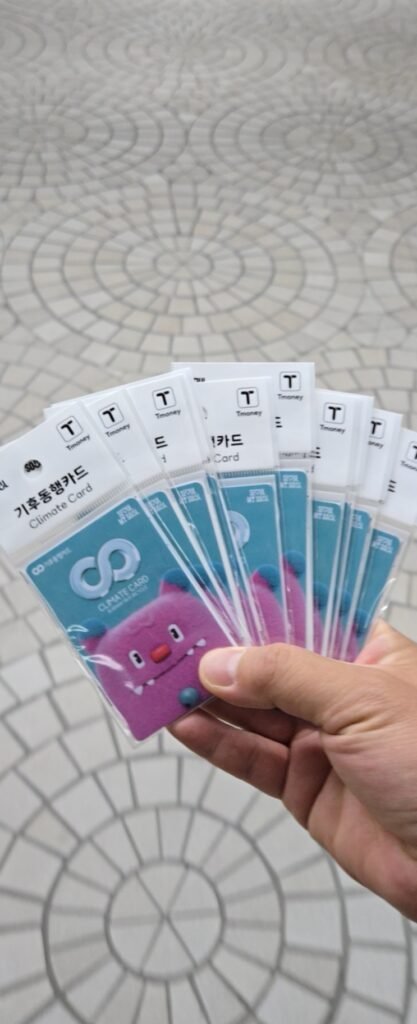
– Attention! those who only know T-money Card
Compared to other developed countries, Korea has affordable public transportation and is connected to most tourist destinations, which is a great advantage for budget-conscious travelers.
The table below shows Seoul’s public transportation fares as of August 2025. Considering a country with a per capita GDP of $35,000, these are remarkably low prices.
<Table.1> Seoul Public Transportation Fare Table
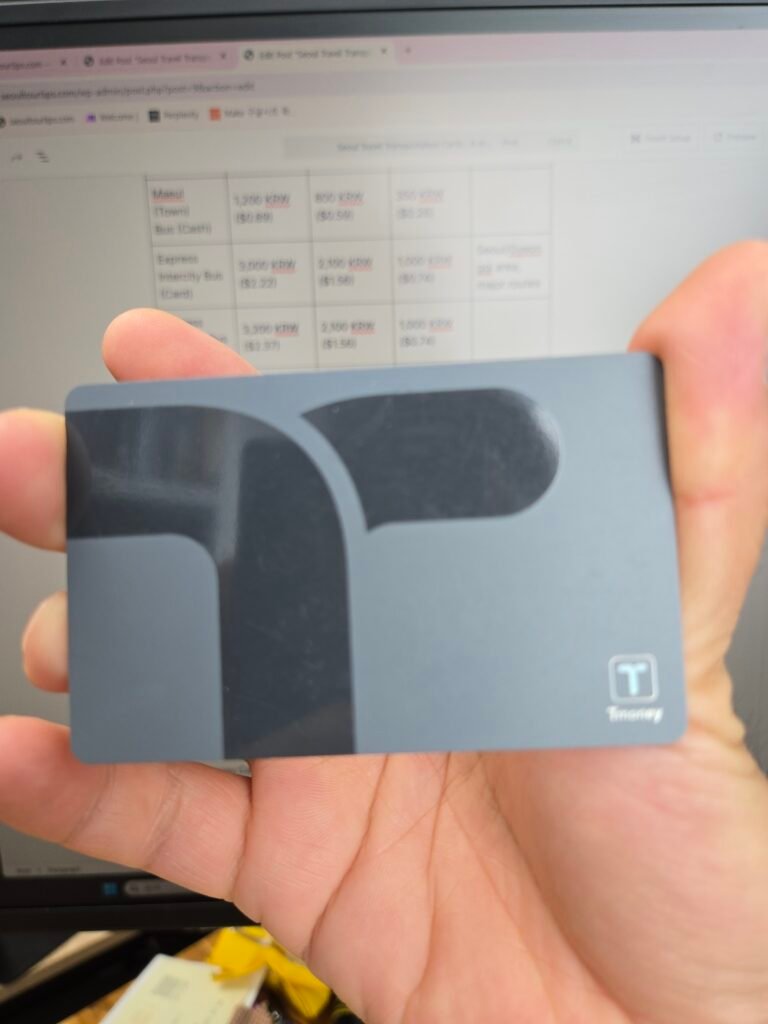
<Table.2> Types of transportation cards
There are various transportation cards in Korea, but foreigners, especially short-term travelers, should pay attention to three of them.
- T-money Card
- Climate Companion Card
- Discover Seoul Pass
The most Basic transportation card is the T-money
1. T-money Card
The T-money card is a cashless prepaid electronic payment system for using Seoul’s public transportation network. Users simply tap their card on the sensor when boarding or exiting subways and buses.
The system automatically calculates the fare and displays the remaining balance. This card offers savings compared to cash payments. In addition to a small fare discount (see Seoul Public Transportation Fare Table 1), when transferring to other modes of transportation, the combined fare is calculated based on the distance traveled, resulting in a lower fare than if the individual modes were used separately.
In addition to the transportation card, it can also be used for payments at some convenience stores (CU, 7-Eleven, GS25, Emart24, Homeplus, GS Supermarket), McDonald’s, Lotteria, and others (though not widely used). However, it can only be used where the T-money logo is visible. (In fact, from my personal experience, just as I’ve never used the Octopus card for anything other than transportation in Hong Kong, I’ve never used the T-money card for anything other than transportation.)
Unlimited use of public transportation for a given period!
2. Climate Companion Card – Ultimately, this is why I wrote this blog.
Since the Climate Companion Card was only released recently, there’s a lot of misinformation out there, like claims that it’s only available to Koreans or that you need to register your passport.
You can ignore all of this information. It only applies to Koreans or registered aliens in Korea who are staying long-term. There’s a separate Climate Companion Card for tourists staying short-term.
The card I most recommend to foreign tourists visiting Seoul is the Climate Companion Card short-term pass.
Since it allows unlimited use of public transportation for a certain period of time, if most of your planned visits are in Seoul and you plan to travel extensively using public transportation, purchasing the Climate Companion Card is a definite advantage.
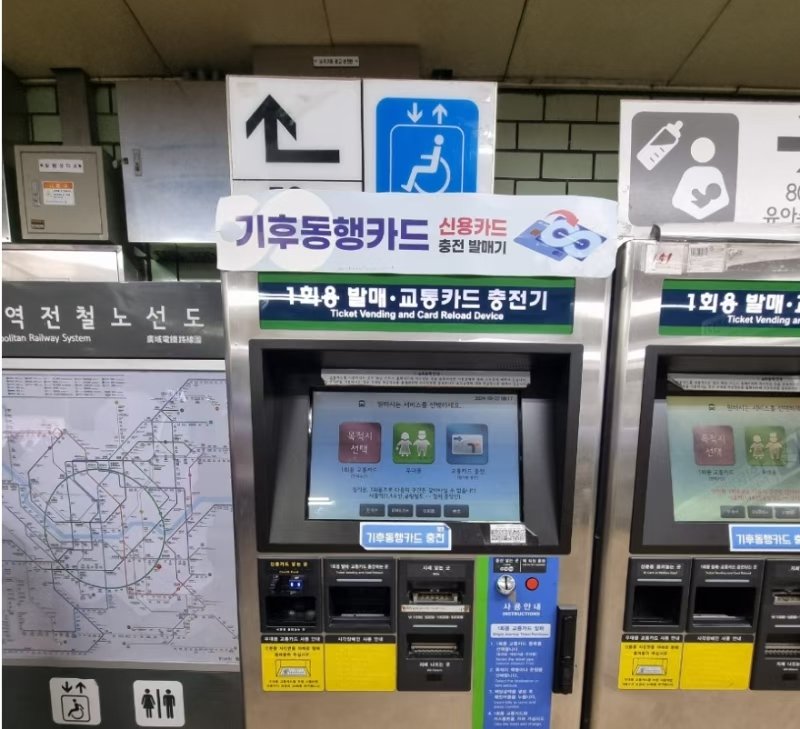
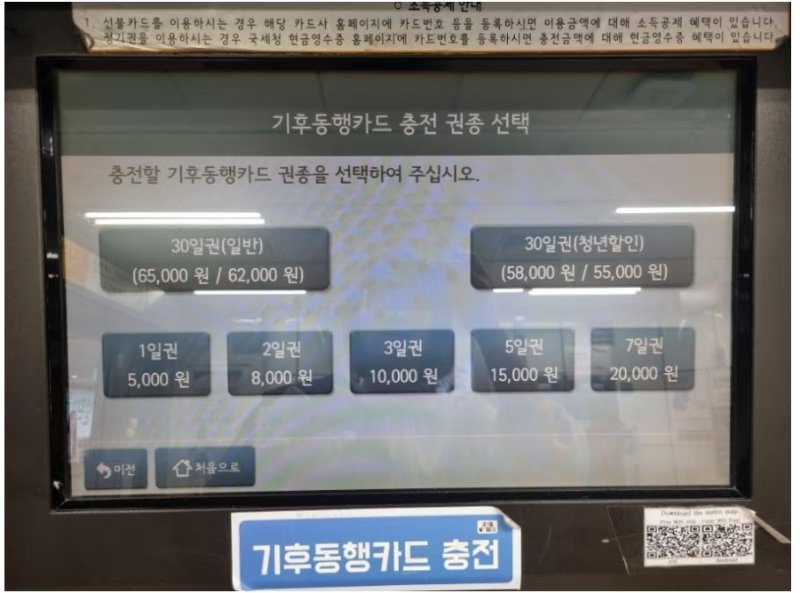
The Climate Companion Card Short-Term Pass offers flexible travel options, from one to seven days, for tourists and short-term visitors. After purchasing a blank physical card worth 3,000 won, you can recharge it with 5,000 won for a 1-day pass, 8,000 won for a 2-day pass, 10,000 won for a 3-day pass, 15,000 won for a 5-day pass, or 20,000 won for a 7-day pass, allowing you unlimited public transportation during the validity period. The 7-day pass is particularly ideal for exploring Seoul for a week, and at a very reasonable price of 20,000 won, it offers significant discounts compared to T-money and other similar cards.
Convenience stores reportedly sell physical cards, but when I tried to purchase one myself, I often found they didn’t have them (convenience stores in Insa-dong and Ikseon-dong). Even if you purchase a physical card, recharging is only possible at subway station kiosks. Therefore, I recommend purchasing a physical card at a subway station customer service center without any hassle.
The Climate Change Card is activated immediately upon recharging, so it shouldn’t be recharged in advance as a gift or for travel. Therefore, recharging a card in advance as a gift for a friend is not a good idea.
Contrary to common misconceptions about registration requirements, the short-term pass is an anonymous ticket that doesn’t require passport registration or personal information verification. Foreign tourists can purchase a physical card for 3,000 won, select their desired period of stay at the card recharger, and immediately begin using the service without any administrative procedures.
After recharging, simply tap the card at any public transportation entrance or exit to use it freely. There’s no need to worry about balance or recharge during the period of use.
The valid zones are clearly specified. It cannot be used on the Seoul Subway (Lines 1-9 and some metropolitan extension lines), all city buses, airport/express buses, intercity/Airport Railroad, or subways outside of the designated zones.
In other words, it can be used within Seoul, but not outside of Seoul. I’ve given this card to my foreign friends, and they haven’t encountered any issues. Since tourists are unlikely to visit places where the Climate Companion Card service isn’t available, you can safely ignore it.
Registration is optional for short-term users, but if you want to use the same card for future visits or want a money-back guarantee, you can register through the T-money website. However, no additional transportation benefits are provided to one-way tourists.
It looks a bit rich, though…
3. Discover Seoul Pass
The Discover Seoul Pass provides free entry to over 70 main attractions in Seoul. Here are some representative places included (full list available on the official website):
- Gyeongbokgung Palace
- Changdeokgung Palace
- Changgyeonggung Palace
- Deoksugung Palace
- Jongmyo Shrine
- Seodaemun Prison History Hall
- National Museum of Korea
- National Museum of Modern and Contemporary Art (Seoul)
- Namsangol Hanok Village
- Museum Kimchikan
- Leeum Samsung Museum of Art
- Seoul Battleship Park
- Simone Handbag Museum
- Jippul Folk Museum
- Hanbok rental (Hanboknam)
- 63 Building (Observatory & Aquarium)
- N Seoul Tower (Observatory)
- Seoul Animation Center
- Running Man Ep1. Treasure Hunt
- Lotte World Adventure (Major Theme Park)
- Alive Museum
- Seoul Zoo & Sky Lift
- Sillala Sauna & Jjimjilbang
- E-Land Cruise
- COEX Aquarium
- Trick Eye Museum
- Football Pentazium
- Figure Museum W
- Tejiem Seoul
Other benefits
- Free one-way airport train (AREX) ticket, city tour bus, public bike (Ddarungi) 24 hours, and a free USIM/eSIM for one day are included.
- Over 100 additional venues provide substantial discounts (shopping, classes, shows).
Value Comparison Table: With & Without Discover Seoul Pass
Below is a sample cost comparison for a 48-hour Seoul itinerary with and without the Discover Seoul Pass, focusing on major paid attractions most popular with foreign visitors.
<Table.3> Comparison of using the Seoul Discovery Pass and not using it
| Option | Upfront Cost | Example of Sites Visited | Estimated Total Cost (KRW) | Explanation |
|---|---|---|---|---|
| 48-hour Discover Seoul Pass | 70,000 KRW | Lotte World, N Seoul Tower, 63 Building, Leeum Museum, Gyeongbokgung, Changdeokgung Palace, National Museum, more | 70,000 KRW (fixed, covers all visits) | Free entry to 70+ paid attractions, no extra charge |
| Without Pass | No upfront fee | Same list (entrance paid at each site) | ~113,000 KRW | Pay entrance separately (Lotte World: 57,000, N Seoul Tower: 10,000, 63 Building: 30,000, Leeum: 10,000, Gyeongbokgung: 3,000, Changdeokgung: 3,000, National Museum: free) |
- If you visit just these five major paid sites (Lotte World, N Seoul Tower, 63 Building, Leeum, and two palaces), you’d already spend approximately 113,000 KRW if buying tickets individually. The pass offers significant savings if you plan to visit several main attractions within its validity period.
- The more places (especially expensive ones) you visit, the more advantageous the Discover Seoul Pass becomes.
in conclusion
For flexible travel across Korea with no time pressure, the T-money Card is sufficient. If you want unlimited rides on Seoul public transit during an intense 2–7 day visit, the Climate Companion Card short-term pass is your best value. If your aim is to see many famous attractions quickly and maximize sightseeing savings, especially as a first-time visitor, the Discover Seoul Pass provides the most benefits when fully utilized. Choose based on your travel pace and focus!
<Table.4> Comparative analysis of the purpose of use for recommended cards
| Card Type | Strengths | Weaknesses | Who Should Use It? |
|---|---|---|---|
| T-money Card | – Widely available (convenience stores/airports), very easy to buy/recharge – Usable nationwide for buses, subways, some taxis and stores – Pay-as-you-go: only pay for actual use – Refundable remaining balance | – No unlimited ride option – No tourist attraction discounts – Standard fares only, no extra savings for heavy use | – Casual tourists – Slow-paced travelers – Visitors needing frequent intercity or flexible transport |
| Climate Companion Card (Short-term Pass) | – Unlimited rides on Seoul subway & buses for a set consecutive period (1/2/3/5/7 days) – Excellent value for frequent/active city travelers – Easy to buy at stations/local shops – No Korean ID needed – Eco-friendly travel option | – Only valid in Seoul (not outside the city) – Doesn’t include airport/express/intercity buses or premium lines – Must pay upfront for duration | – Busy, sightseeing-focused visitors – Travelers planning to take many subway/bus trips in Seoul in a short period |
| Discover Seoul Pass | – Includes T-money transit function – Free entry to 70+ major Seoul attractions – Big savings for packed itineraries – Extra discounts for shows, restaurants, shopping – Free airport train, city tour bus, etc. | – High upfront cost – Only worth it if visiting several premium sights – Strict duration (24/48/72hr) use | – First-time tourists – People planning to visit multiple paid attractions in 1-3 days – “Power tourists” seeking maximum value per day |
Pingback: Seoul Travel Accommodation Savings Guide: How to Choose Budget-Friendly Accommodations – SeoulTourTips.com
This is the first time in my life that Korea has been this hot in the summer. Perhaps global warming is naturally affecting Korea as well.